Arts · 4 min read
Art Is Not a Free Period
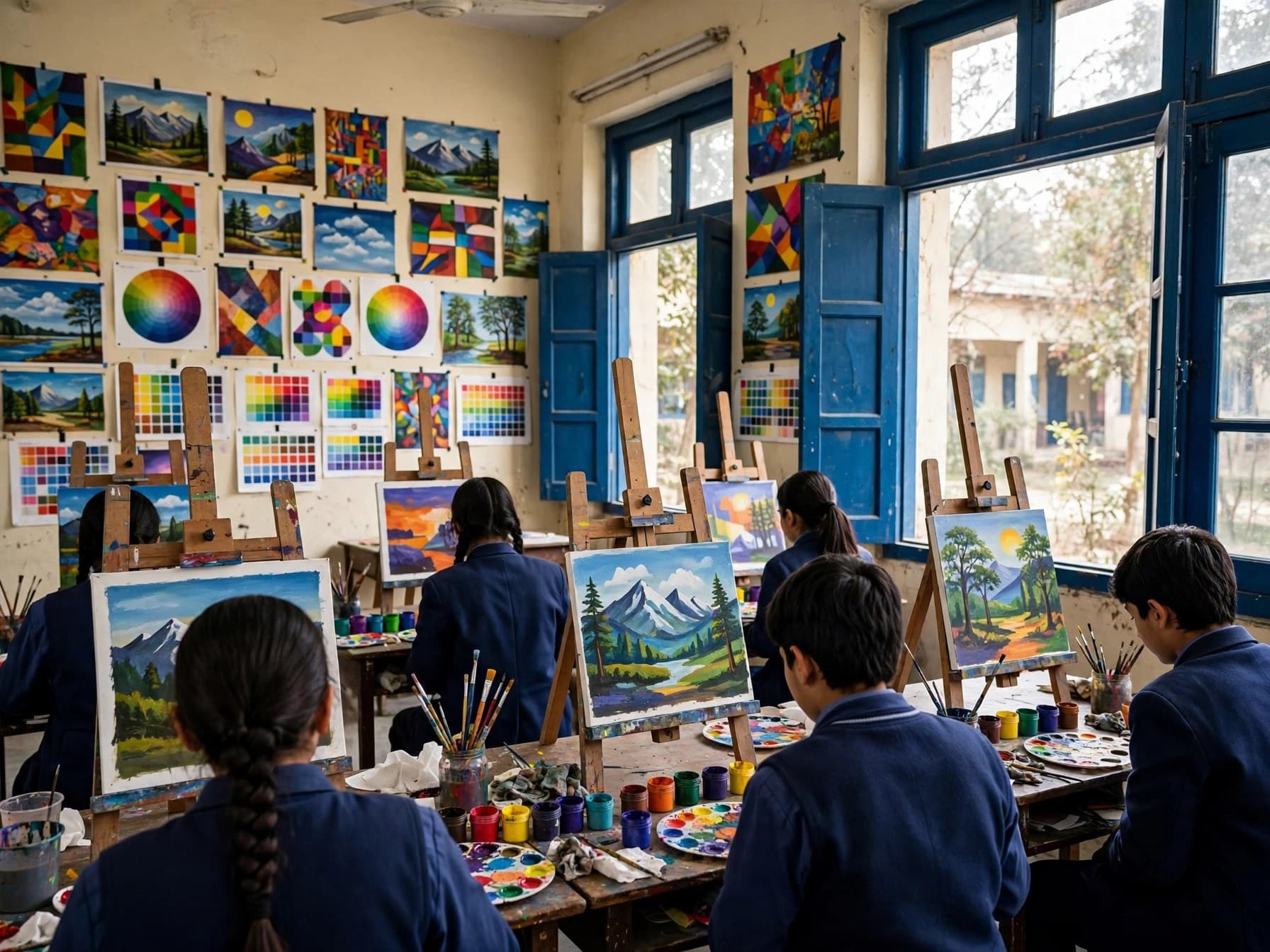
Every school has that one timetable slot parents and children quietly call the free period. In too many schools, it is art. We run our art classes differently, and if you stand at the art room door for five minutes you will see why: thirty children, completely silent, completely absorbed, working harder at a painting than they worked at anything all morning.
What a paintbrush does for a child's hands
Before it is anything else, art is physical training. Holding a brush steady, cutting along a line, mixing a colour until it matches what is in your head — these are fine motor skills, the same small-muscle control a child needs for neat, fast handwriting in every exam they will ever sit. Young children who paint and draw regularly write better, and it is not a mystery why.
Older students gain something else: control and patience with materials. Paint does not undo. A colour mixed wrong must be fixed forward, not erased — a useful lesson in a world of delete keys.
Confidence that walks into other classrooms
There is no single right answer in art, and for some children that is a first. The boy who is mid-pack in maths discovers he has the best eye for colour in the class. The girl who never speaks in assembly explains her painting to visitors without a flicker. Teachers see that confidence leak, happily, into other subjects over the following weeks.
Our paintings wall matters here. Finished work goes up in the corridor where the whole school passes it, with the child's name underneath. Being publicly good at something changes how a child walks into school in the morning.
How our art classes are actually run
Each term has a loose arc — colour, then line and shape, then building and collage — and each project teaches one real technique before children are let loose with it. A lesson might start with five minutes on how to load a brush or shade from dark to light, and the remaining time belongs to the children and their own ideas.
We exhibit the results at school events, and the science exhibition now has an art corner that parents visit as faithfully as the volcano. The two were never really separate subjects anyway.
Materials are kept simple and honest: proper brushes, thick paper that does not disintegrate, colours that actually show up. Children can tell when they have been handed the cheap version of a subject, and they value it accordingly. Good materials are a small cost with an outsized message — your work matters here.
Creativity is not the opposite of discipline
Parents sometimes worry that time on art is time taken from 'serious' study. Our results suggest the opposite relationship. Children who learn to look carefully, persist with a difficult piece and judge their own work honestly bring those exact habits back to science projects, essays and exam revision. Art classes are not a reward for finishing real work. At Apna Home School in Shujabad and Multan, they are part of how the real work gets done.
Next time you visit us, ask to see the paintings wall before you ask about results — it will tell you a great deal about the school. Call or WhatsApp +92 312 6621457 to arrange a visit, Monday to Saturday, 8 AM to 4 PM, and come and see the art room in full, noisy, colourful session.
Admissions Open in Shujabad & Multan
Fees from Rs. 1,500/month. Scholarships available for deserving students. Visit us Mon–Sat, 8 AM to 4 PM, or call us today.
Read Next