Technology · 4 min read
What Actually Changes When a Classroom Goes Smart
Ask any child what they remember from last week's lesson and they will rarely mention a page number. They remember the volcano that erupted on screen, or the quiz their team won by one point. That is why we invested in smart classes at Apna Home School — not to look modern, but because lessons land differently when children can watch an idea move instead of only hearing it described.
Diagrams that move, not just sit on the page
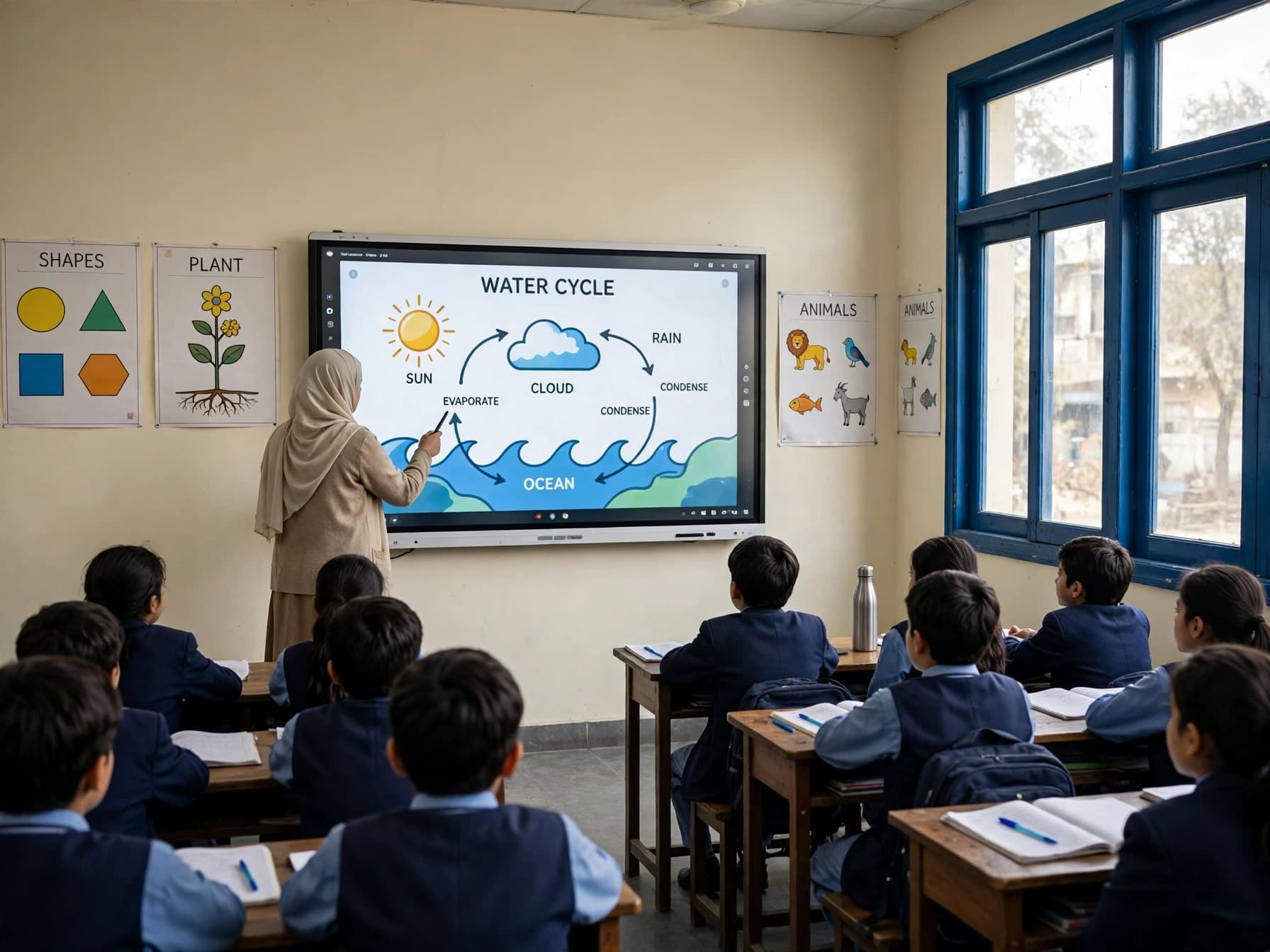
In a science lesson, a printed diagram of the water cycle is four arrows and a cloud. On the smart board, the water rises, forms clouds and falls as rain in front of the class, and the teacher can pause it, rewind it and ask, 'What happens next?' Children who never raised a hand for the textbook version suddenly have opinions. Maths works the same way. A fraction stops being an abstract number when a teacher drags a circle into equal parts and colours one slice at a time.
Geography is another quiet winner. Instead of memorising that Multan sits on the Chenab, the class zooms into a real map and traces the river with a finger. The lesson takes the same forty minutes. It just leaves more behind.
Instant quizzes tell the teacher the truth
The most useful part of smart classes is not the screen. It is the two-minute quiz at the end of a lesson. Every child answers, the results appear at once, and the teacher can see exactly which question half the class got wrong. No guessing, no waiting a week for copies to be marked.
If twelve children confused area with perimeter, tomorrow's lesson starts there — not three chapters later when the test exposes it. Parents hear about these small checks in the monthly report, so nothing builds up silently.
The teacher is still the most important technology
A board cannot notice that a child at the back has gone quiet. It cannot tell when an example about a cricket match will land better than the one in the book. Our teachers decide what appears on the screen, when to switch it off, and when a simple chalk explanation is honestly the better tool. Some of our best lessons still start with nothing but a question written by hand.
The screen serves the lesson. The moment it starts running the lesson, we have a problem — and our teachers know the difference.
What parents should ask about smart classes
If you are comparing schools, do not ask whether they have smart boards. Ask how often they are used, and for what. A board that plays a video once a month is furniture. A board used daily for diagrams, worked examples and end-of-lesson checks is a teaching tool. You are welcome to sit in on a lesson at our Shujabad or Multan campus and judge the difference yourself — that offer is genuine, and parents take us up on it every month.
One more honest point: screens tire children if they run all day, so our teachers mix board work with books, copybooks and discussion in every lesson. The board gets perhaps half of each period. The rest is the ordinary, irreplaceable business of a teacher and a class talking to each other.
Smart classes work because they respect how children actually learn: by seeing, answering and being corrected kindly and quickly. If you would like to watch one in action, call or WhatsApp us on +92 312 6621457 and we will arrange a visit during school hours, Monday to Saturday, 8 AM to 4 PM.
Admissions Open in Shujabad & Multan
Fees from Rs. 1,500/month. Scholarships available for deserving students. Visit us Mon–Sat, 8 AM to 4 PM, or call us today.